
Part of the Why Strategies Fail: The AI Factor series
The Flywheel Effect: Why Some Startups Compound While Others Grind
You're working harder than ever, but progress feels linear. Every customer is a new fight. Every month starts from zero. You're pushing a boulder uphill, and the moment you stop pushing, it rolls back down.
Then you see companies that seem to accelerate effortlessly. Each customer brings the next. Each feature makes the product stickier. Each month builds on the last. They're not working less hard—they're working on something that compounds.
The difference isn't luck. It's flywheels.
Flywheels vs. Funnels
Most startups think in funnels: top of funnel → middle of funnel → bottom of funnel → customer. Linear. Sequential. Leaky.
The problem with funnels is that they don't compound. You pour resources in at the top, some percentage drips out the bottom, then you repeat forever. Growth requires constantly increasing the pour.
Flywheels work differently:
| Funnels | Flywheels |
|---|---|
| Linear flow | Circular momentum |
| Each stage independent | Each output becomes next input |
| Requires constant new input | Momentum builds over time |
| Same effort = same results | Same effort = increasing results |
| Growth through addition | Growth through multiplication |
| Stops when you stop pushing | Continues spinning with less force |
| Optimize each stage separately | Optimize the connections between stages |
A funnel is a machine. A flywheel is a system.
Anatomy of a Flywheel
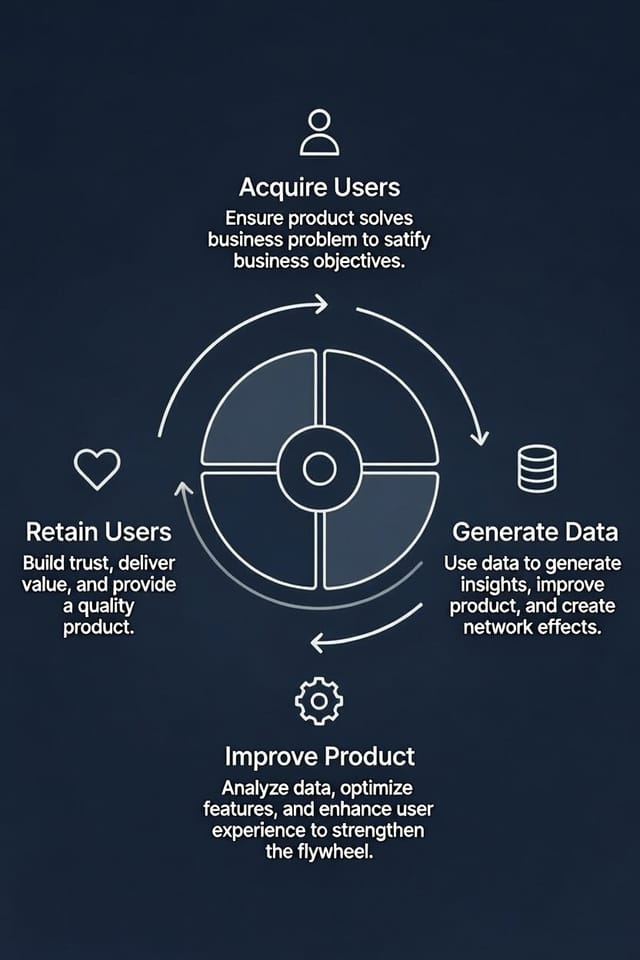
Figure: A business flywheel where each stage reinforces the next—users generate data, data improves the product, better products retain users, and retained users attract new users.
Every effective flywheel has four properties:
1. Reinforcing Loops
Output from one stage feeds input to another. More customers → more data → better product → more customers. The loop closes. Each cycle strengthens the next.
Without a loop, you have a process. With a loop, you have compounding.
2. Momentum
Early pushes are hard. Later pushes add to existing speed. The same effort produces more results over time.
This is the physics that makes flywheels powerful—and the reason most founders quit before they work. The first rotations feel like wasted effort. They're not. They're storing energy.
3. Friction Reduction
As the wheel spins, you identify and remove what slows it. Each rotation is smoother than the last. Friction that was invisible at low speed becomes obvious at high speed.
Flywheel optimization is less about pushing harder and more about removing resistance.
4. Compounding Returns
The system doesn't just grow linearly—it grows exponentially. A 10% improvement to a spinning flywheel beats a 50% improvement to a static one.
This is why timing matters. The earlier you get the flywheel spinning, the more rotations it completes, the more the improvements compound.
Famous Flywheels
Amazon
Lower prices → More customers → More sellers → More selection → Lower prices (economies of scale)
Jeff Bezos drew this on a napkin. Two decades later, it's still spinning—faster than ever. Every element reinforces every other element. Competitors can copy individual tactics but can't replicate two decades of accumulated momentum.
HubSpot
Free tools → Leads → Users → Content creation → SEO traffic → More leads
They didn't outspend competitors on ads. They built a content and product flywheel that compounds. Each piece of content attracts users who create more content that attracts more users.
Slack
Teams adopt → More messages → More integrations → Harder to leave → Teams recommend → More teams adopt
Network effects plus switching costs equals flywheel moat. The product becomes more valuable and more sticky with each rotation.
Tesla
More vehicles sold → More driving data → Better autonomous software → Higher vehicle value → More vehicles sold
Tesla's flywheel isn't just about cars—it's about data accumulation. Every mile driven by every Tesla feeds the neural network that makes all Teslas better. Competitors selling fewer vehicles collect less data, train worse models, and fall further behind.
Creator Economy Pattern
Content published → Audience growth → Sponsorship revenue → Investment in better content → Larger audience → More sponsorships
Individual creators demonstrate the same flywheel physics as billion-dollar companies. The creator who reinvests early revenue into better equipment, editing, and consistency builds momentum that compounds—while competitors starting later face an ever-widening gap.
Notice what these have in common: each company's flywheel is unique to their business model. You can't copy Amazon's flywheel and apply it to a SaaS startup. You have to discover your own.
The Cold Start Problem
Here's the hard truth: every flywheel feels like a grind at the beginning.
The wheel is heavy. It barely moves. You push with everything you have and it rotates a few degrees. Most founders quit here. They switch to something with faster feedback loops.
But that's exactly when you're building the potential energy that will pay off later.
The cold start is the moat. If it were easy to get a flywheel spinning, everyone would have one. The difficulty of the early pushes is what makes a spinning flywheel defensible. Competitors would have to start from zero while you're already at speed.
The question isn't whether the first push is hard—it always is. The question is: are you pushing something that will compound, or something that will always be this hard?
A treadmill requires the same effort to maintain the same speed. A flywheel requires effort to build speed that then maintains itself.
Common Flywheel Failures
Not every attempt at a flywheel succeeds. These patterns explain why some wheels never spin:
Mistaking Tactics for Loops
Paid acquisition isn't a flywheel—it's a funnel. You pay, you get customers, you pay again. There's no reinforcing loop unless those customers create organic acquisition through referrals, content, or network effects. Many startups call their growth strategy a "flywheel" when it's actually a paid funnel with no compounding mechanism.
Loops That Don't Close
A flywheel requires output to become input. If your customers generate data but that data doesn't improve the product, the loop is broken. If users create content but that content doesn't attract new users, there's no flywheel—just a feature. Map the complete loop. If any stage doesn't feed the next, the wheel won't spin.
Ignoring External Friction
Flywheels exist in markets, not vacuums. A perfectly designed flywheel can be stopped by external forces: regulatory changes, platform dependency, market shifts. Amazon's flywheel nearly stalled in the early 2000s due to cash constraints. The mechanism was sound; the environment was hostile. Flywheels need both internal design and external conditions.
Premature Optimization
Some founders obsess over flywheel efficiency before achieving flywheel existence. Reducing friction by 10% matters when the wheel is spinning. It's meaningless when the wheel hasn't completed a single rotation. First, prove the loop closes. Then optimize.
How to Find Your Flywheel
Most founders can't draw their flywheel. They have tactics, channels, activities—but not a reinforcing loop.
Ask yourself:
1. What gets easier the more we do it?
If nothing gets easier, you don't have a flywheel. You have a series of disconnected activities. Look for the work that creates leverage—where doing it once makes doing it again faster, cheaper, or more effective.
2. Where does output become input?
What customer behavior feeds back into the system? Do customers create content, invite others, generate data that improves the product? If outputs disappear rather than recirculate, the loop isn't closed.
3. What would make customers bring other customers?
Not referral programs—those are tactics. Look for structural reasons why one customer's success creates another customer's interest. What would make word-of-mouth inevitable rather than incentivized?
4. What data or context accumulates over time?
What do you have at month 12 that you didn't have at month 1? Customer behavior data? Training examples? Network density? Content library? If you're not accumulating an asset, each month starts fresh.
5. What would a competitor have to replicate?
If they could copy your features but not your flywheel, what would they be missing? The answer reveals your potential moat. If there's nothing they couldn't copy, you don't have defensibility.
If you can answer these questions, you can draw your flywheel. If you can't, you might be building a treadmill instead—running hard but staying in place.
Measuring Flywheel Health
Most metrics measure outputs: revenue, users, growth rate. These tell you how big the wheel is, not how fast it's spinning or whether it's accelerating.
Flywheel metrics measure the loop itself:
Momentum
Is the same effort producing more results than last month? Track the ratio of input to output over time. Beware of vanity metrics that show activity without compounding. If you're putting in the same effort and getting better results, momentum is building. If results are flat or declining relative to effort, something is slowing the wheel.
Velocity
How fast does output become input? Measure the time from one stage to the next:
- Customer → referral → new customer: days? weeks? months?
- Content published → traffic generated → leads captured: what's the cycle time?
Faster cycles mean more rotations. More rotations mean more compounding.
Friction
What's slowing each stage? Where do loops break? Map your flywheel and measure the conversion or completion rate at each transition. The lowest rates indicate where friction is highest.
Acceleration
Is the wheel speeding up, steady, or slowing down? This is the meta-metric. Plot your velocity over time. An accelerating flywheel will beat a faster but decelerating one. Every time.
A startup with a small but accelerating flywheel will beat a startup with a large but decelerating one. The former has compounding in its future. The latter has decay.
Friction Kills Flywheels
The enemy of compounding is friction. Every point of resistance in the loop slows the wheel and bleeds energy.
What makes friction dangerous is its invisibility at low speed. When you're pushing hard and the wheel barely moves, you can't distinguish between "heavy wheel" and "friction-filled system." Only when momentum builds does friction become obvious—and costly.
Common Friction Points
Onboarding complexity — Users can't get value fast enough to complete the loop. If it takes weeks to see benefit, the flywheel stalls before it starts. Time-to-value is friction.
Manual processes — Humans bottleneck what should be automatic. Every manual step is a potential break in the loop. Automation isn't about efficiency—it's about keeping the wheel spinning continuously.
Value delay — Too long between input and output. If customers have to wait months to see results, they can't reinforce the loop. Compress the cycle.
Switching ease — Users can leave before the loop locks in. If there's no accumulating value, no network effects, no switching costs, then users leave before they can contribute to the next rotation.
The Compounding Effect of Friction Reduction
Your job isn't just to spin the wheel. It's to continuously identify and remove friction.
Here's why this matters: a 10% friction reduction compounds across every rotation. If your flywheel completes 12 cycles per year, a 10% improvement doesn't give you 10% more results—it gives you 10% improvement on the first cycle, which feeds into 10% improvement on the second cycle, which compounds through all 12.
Friction reduction is the highest-leverage work you can do on a spinning flywheel.
The Moat Is the Spin
Once a flywheel is spinning fast enough, competitors face an impossible choice:
Copy the model — But they start from zero momentum while you have years of spin. Every month they spend building, you're still accelerating. The gap widens.
Compete differently — But you've defined the game and the rules. Customers compare alternatives to your flywheel, not to some neutral standard.
Outspend you — But money can't buy accumulated context, compounded value, or embedded workflows. Capital can push a flywheel faster but can't create years of rotation from scratch.
None of these options is attractive. That's the point.
This is why Amazon is so hard to compete with. It's not any single feature—it's decades of flywheel momentum. A new entrant would need to push that same wheel from a dead stop while Amazon's keeps accelerating.
The same principle applies at every scale. A startup with 12 months of flywheel momentum has a real advantage over one starting today—if the flywheel is real.
The Question
Every startup has activities. Few have flywheels.
The difference between grinding and compounding isn't effort—it's whether your effort feeds back into itself.
So: can you draw your flywheel? Do you know what makes it spin? Can you measure whether it's accelerating?
If not, you might be building a treadmill—running hard but staying in place.
If so, your only job is to keep pushing, reduce friction, and let compounding do what compounding does.
The early pushes are the hardest. But they're also the most valuable—because they're the ones your competitors will never be able to replicate.
Key Takeaways
- Funnels are linear; flywheels compound: Outputs become inputs in a reinforcing loop
- Flywheels have four properties: Reinforcing loops, momentum, friction reduction, compounding returns
- The cold start is the moat: Difficulty of early pushes is what makes spinning flywheels defensible
- Find your flywheel by finding loops: What gets easier? What accumulates? What can't competitors copy?
- Measure the spin, not just the size: Momentum, velocity, friction, and acceleration matter more than absolute metrics
- Friction reduction compounds: 10% less friction across 12 cycles creates exponential improvement
Frequently Asked Questions
Continue Reading
- Strategy Is a Living System, Not a Document — Why continuous evolution beats static plans
- The Strategy Execution Gap Explained — Why 70-90% of strategies fail to execute
- Why Identity Is Infrastructure in the AI Era — Building the foundation for compounding value
At Stratafy, we've been thinking about flywheels for strategic systems—how context accumulates, how AI agents get smarter with use, how value compounds over time. But the model is universal. The best companies aren't just executing. They're building systems that make execution easier every day. That's the flywheel effect.
Beyond OKRs: Why Goals Are Not Strategy
OKRs measure activity, not alignment. Learn why goal-setting frameworks miss the strategic layer that determines whether execution actually matters—and what the gap reveals about organizational infrastructure.
Decision Velocity: How the Best Teams Make Choices Faster
Most teams optimize for decision quality. The fastest teams optimize for decision speed. Learn the frameworks that enable velocity without recklessness.