
The AI Price Divide in 2026: Why You're Paying 50x More for Diminishing Returns
Published late May 2026. All prices verified against official provider and aggregator pages at time of writing; AI pricing moves fast, so check the provider pages before acting on specific numbers.
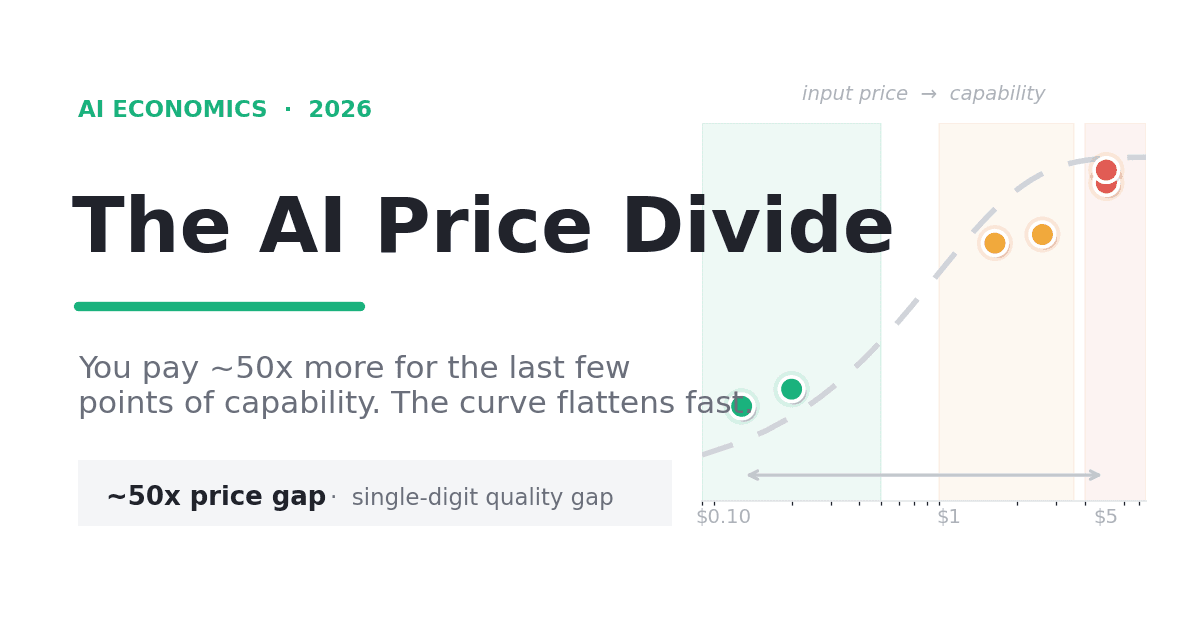 Figure: Price plotted against capability across the 2026 tiers — steep gains climbing out of the bottom, then a long flat plateau at the frontier.
Yesterday, Anthropic shipped Claude Opus 4.8. It's a genuinely strong model — sharper judgment, better agentic performance, and the long-context coherence the Opus line is known for. On the hardest evaluations, it sits at the front of the pack.
It also costs $5 per million input tokens (and $25 per million output).
At the same time, you can run genuinely capable models for $0.10–0.20 per million input tokens. Across the range of models you'd seriously consider putting into production, that's a ~50x price spread.
For most of the last few years, the operating assumption was simple: use the best model you can afford, because the quality difference justifies almost any price. In 2026, that assumption quietly stopped being true for most workloads. The question is no longer "which model is smartest?" It's "how much extra capability am I actually buying with that 50x premium — and on which calls do I genuinely need it?"
This post lays out the current landscape, the two shifts that changed the economics, and a practical framework for deciding where to spend.
The three tiers, late May 2026
The market has settled into three reasonably clear bands. Here's where the major models sit and what they cost per million tokens (input / output).
| Tier | Models | Input | Output | Notes |
|---|---|---|---|---|
| Ultra-budget (<$0.50/M) | Gemini 2.5 Flash-Lite ($0.10), DeepSeek V4 Flash ($0.14), Grok 4.1 Fast ($0.20) | $0.10–0.20 | $0.28–0.50 | Fast, cheap, 1M context common |
| Value ($1.25–3/M) | Grok 4.3, Gemini 3.1 Pro, GPT-5.4, Claude Sonnet 4.6 | $1.25–3 | $2.50–15 | The current sweet spot |
| Frontier ($5+/M) | Claude Opus 4.8, GPT-5.5 | $5 | $25–30 | Best on the hardest problems |
A few specifics worth knowing:
- Ultra-budget models are no longer toys. DeepSeek V4 Flash ($0.14/$0.28) and Gemini 2.5 Flash-Lite ($0.10) handle summarization, classification, standard RAG, and routine coding well, and most ship a 1M-token context window. When you need volume or low latency, this tier is hard to beat.
- Value is where the majority of serious production work should live. Grok 4.3 ($1.25/$2.50), Gemini 3.1 Pro ($2/$12), GPT-5.4 ($2.50/$15), and Claude Sonnet 4.6 ($3/$15) all deliver strong reasoning, good coding, and solid long-context handling at a fraction of frontier cost.
- Frontier still earns its place on the hardest work — complex multi-step agents, deep long-context reasoning, the highest-stakes coding. Claude Opus 4.8 ($5/$25) and GPT-5.5 ($5/$30) lead here. But the marginal gain over the top of the value tier has narrowed to roughly single digits on most tasks, and you pay several times more to get it.
One naming note worth holding onto: GPT-5.4 and GPT-5.5 are different models at different prices. GPT-5.4 is the value option at $2.50/$15. GPT-5.5 is the newer, pricier sibling at $5/$30 — which is why it sits in the frontier row, not the value one.
Why the curve flattens so hard
Plot price against capability and you get the shape in the chart above: steep gains as you climb out of the bottom, then a long, flat plateau at the top. That plateau is the whole story.
On the most difficult tasks, frontier models genuinely lead. But past a certain capability threshold, each additional point of intelligence becomes dramatically more expensive to buy. And most real workloads don't need maximum capability on every call. They need:
- Good-enough reasoning
- Reliable tool use
- Strong long-context handling
- Reasonable speed and cost
That's precisely the profile the value tier now hits. The biggest quality jumps already happened lower in the stack. Paying 5–10x more at the top buys marginal gains on the 70–90% of queries that aren't actually hard.
The two shifts that changed the economics
The price spread alone doesn't tell the whole story. Two developments in 2026 changed what you actually pay — and they matter more than the sticker prices.
1. Long context stopped being a luxury tax
This is the freshest shift, and the one most teams haven't priced in. Claude Opus 4.8 and Sonnet 4.6 now run the full 1M-token context window at standard pricing — no premium multiplier. A 900K-token request bills at the same per-token rate as a 9K one. That used to carry a surcharge; with the move to general availability, it doesn't.
Not everyone dropped the tax, though, so read the fine print:
- Gemini 3.1 Pro jumps from $2/$12 to $4/$18 above 200K tokens — and once you cross that line, all tokens in the request bill at the long-context rate.
- GPT-5.5 applies a 2x-input / 1.5x-output uplift above ~272K tokens, for the rest of the session.
- Claude stays flat all the way to 1M.
"1M context" and "1M context at one flat price" are different products. If your workload is context-heavy, that distinction can dominate your bill.
2. Caching became the great equalizer
Every major provider now offers prompt caching. Cache a large document, codebase, or system prompt once, and follow-up queries hit it at a fraction of the input cost — commonly 70–90% savings on context-heavy work like RAG, repository analysis, and long iterative chats.
Current cached-input rates give a sense of the magnitude:
- Claude Opus ~$0.50/M, Sonnet ~$0.30/M
- Grok ~$0.20/M
- DeepSeek V4 Flash ~$0.003/M
A concrete example: suppose you run an assistant over a 500K-token codebase and answer 50 questions against it in a session. Without caching, you pay full input price on all 500K tokens for every question. With caching, you pay full price once to populate the cache, then a small fraction on each subsequent query. On Sonnet 4.6, that's the difference between paying ~$3/M repeatedly versus ~$0.30/M on the cached bulk — roughly a 90% cut on the dominant cost.
Stack the batch API (typically −50% on async jobs) on top, and a "$5 model" can behave like a $0.50–1 model on the work that matters. The sticker price is the worst case, not the bill you actually pay.
A practical framework: where to spend
The winning pattern isn't "pick one model." It's routing — sending each call to the cheapest tier that can handle it, and escalating only when the task genuinely demands it.
| Workload type | Recommended tier | Why |
|---|---|---|
| High-volume, simple tasks | Ultra-budget | Best price/performance |
| Most production work | Value tier | The sweet spot |
| Very hard reasoning / complex agents | Frontier | When marginal gains justify the cost |
| Long-context document analysis | Value or Frontier + caching | Caching changes the math entirely |
In practice, four moves capture most of the available savings:
- Route by complexity. Cheap model by default; escalate on detected difficulty or low confidence.
- Cache aggressively anywhere context repeats — system prompts, documents, codebases.
- Batch async, non-latency-sensitive jobs for the extra discount.
- Self-host open weights when volume or data-privacy requirements tip the economics.
This is fundamentally a resource-allocation problem, not a model-selection problem. The teams that get it right treat their AI spend the way they'd treat any other budget — and the way good operators treat every high-leverage decision: put the money where it creates value, and don't overpay for capability you won't use. As AI agents take on more of the actual work, that discipline stops being a nice-to-have and becomes a line item that compounds.
The bottom line
Claude Opus 4.8 is impressive. GPT-5.5 is impressive. But the real story of 2026 isn't how good the frontier models are getting — it's how good the value-tier models have become, and how expensive it now is to buy those last few points of capability.
The price gap is real and extreme. The value-per-dollar gap, once you optimize with routing and caching, is much smaller than the sticker prices suggest. Many teams are overpaying simply by defaulting to one expensive model for everything.
The organizations that win going forward won't necessarily be the ones using the most expensive model. They'll be the ones most disciplined about where they spend their AI budget.
A note on the numbers
Input and output prices are verified against official provider pages and pricing aggregators as of late May 2026 and are subject to change. The capability comparisons in this piece — the single-digit gaps, the "value tier is most of the way to frontier quality" framing — are directional estimates drawn from public leaderboards and benchmark suites, not a single authoritative measurement. Treat them as a map of the landscape, not a precise score. Always validate against your own workload before committing to a model strategy.
Continue Reading
- Decision Velocity — Why how fast you decide matters as much as what you decide
- Your AI Can Access Everything — When agents act on your behalf, the economics and the governance both change
- Four Layers of AI Governance — A framework for controlling what your AI can do and spend
- The MCP Protocol and the Agentic Business — Why agents need protocols, not prompts
Sources: Anthropic — Claude pricing, OpenAI API pricing, Google — Gemini API pricing, xAI API, DeepSeek API pricing. Prices verified late May 2026.
AetherID: The Identity Layer for the Agentic Internet
An open, schema-first identity protocol for the agentic internet — a verifiable profile AI agents can read instead of guessing. Why we built it beside Stratafy.
Why Organizational Identity Is Infrastructure in the AI Era
Mission, vision, and values aren't culture posters—they're the governance layer for AI agents. Learn why identity becomes critical infrastructure when AI acts on your behalf.